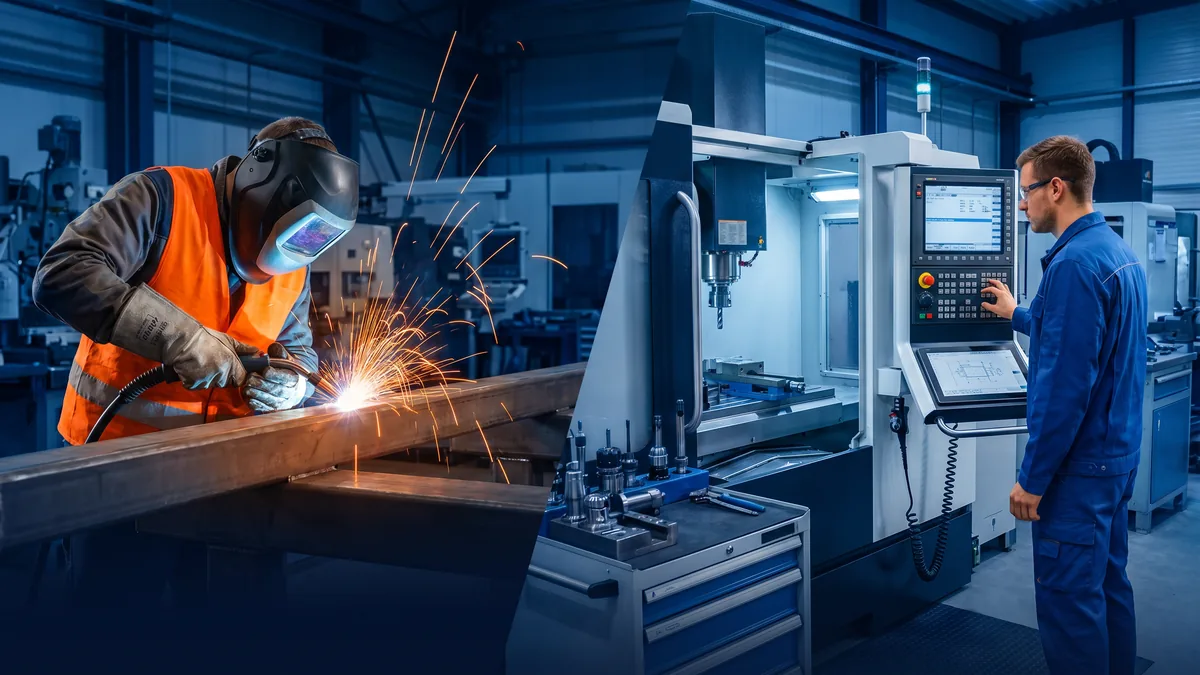
Recruitment of welders, CNC setters, and machinists from abroad is becoming an increasingly common reality for manufacturing companies in Slovakia — not a choice. The domestic labor market simply cannot meet demand, and companies waiting for a "Slovak candidate" wait for months. Meanwhile, qualified welders and CNC setters from Sri Lanka, India, Uzbekistan, or other countries can start work just as quickly — if you have the right partner who knows how to manage the entire process.
The most common concern we hear from manufacturing companies is this: "How do I know that person can really weld, as they claim?" It's a legitimate question. Nobody wants to pay for a plane ticket, arrange a work permit, and accommodation — only to find out that the candidate can't handle the first day on the job. That's why we've developed a system for verifying skills before the candidate even boards a plane.
In this article, we'll explain how these tests work in practice, why they are more reliable than a typical interview, and why employing welders and CNC setters from abroad — or those already working within the EU — can be a strategic advantage for your company, not a compromise.
Why Welders and CNC Setters from Abroad?
Countries like Sri Lanka, India, Uzbekistan, Georgia, and others have a long tradition of technical education. Local polytechnic schools and manufacturing plants produce thousands of graduates annually specializing in welding, metalworking, CNC programming, and assembly. Many of them have experience from export-oriented plants, where quality standards are comparable to European requirements.
It's also important that candidates from these countries are motivated. A job opportunity in Slovakia represents a significant career and financial advancement for them — which directly reflects in their work discipline and long-term loyalty to the employer. Turnover is low if recruitment is done correctly.
For manufacturing companies in Slovakia, this means one thing: with the right selection and skill verification, you gain an employee who not only can do their job but will stay long-term. And that is rare in today's market.
Candidates Already Working in the EU — Faster Onboarding and Simpler Residence Process
Not every candidate has to come directly from their country of origin. We also actively search for experienced welders, CNC setters, and machinists who are already working in other European Union countries — for example, in Poland, Hungary, Romania, Lithuania, Latvia, or other EU member states.
These candidates have several key advantages:
- They have a valid EU residence permit — they can start in Slovakia without a lengthy visa process.
- They have verified experience in a European manufacturing environment and are familiar with European work standards and BOZP regulations.
- They can apply for a temporary residence permit for employment directly in Slovakia at the foreign police department — without the need for a visa.
- After submitting a complete application for temporary residence, they can start working legally immediately — they do not have to wait for the outcome of the proceedings.
- Onboarding time can be less than 4 weeks from initial contact.
This process is significantly simpler and faster than recruiting directly from the home country. However, it should be noted that such candidates have higher salary expectations, as they have experience in the European labor market.
Important: Every candidate with EU experience who is interested in a position with you must undergo a work trial directly at your workplace before starting. We want you to see what the candidate can do and how — not just on paper, but in the real conditions of your operation. We recommend continuing the process only after a successful work trial.
Are you looking for welders or CNC setters for your production?
Arrange a free consultation — no obligations, no upfront payment.
Contact Ergasia →How We Verify Skills of Non-EU Candidates — Online Interviews and Welding Exams
For candidates located outside the EU (Sri Lanka, India, Uzbekistan, Georgia, and other countries), we have developed a remote skill verification system. Every candidate for a welder or CNC setter position must complete a standardized online interview before being shortlisted.
Online Interview — What It Includes
The online interview takes place via video call, where a representative from your company — a foreman, technical manager, or HR — can also join. During the interview:
- The employer can ask the candidate any technical questions.
- Through screen sharing, we can show the candidate technical drawings and verify their ability to read drawings and at what level.
- For CNC setters, we can verify knowledge of G-code, machine setup, workpiece clamping, and tool selection.
- For welders, we verify knowledge of welding methods, materials, and positions.
Welding Exam — According to Employer Requirements
For welders, we can organize a practical welding exam according to your company's precise requirements. Just tell us:
- What material (steel, stainless steel, aluminum...)
- What welding method (MIG/MAG, TIG, electrode...)
- What welding position
- What tolerances and standards (e.g., ISO 9606)
We can document the exam in two ways:
- Video recording: The candidate performs the exam, we record a video, and send it to you for assessment. Your technician or foreman performs the evaluation — we do not have our own technical evaluators.
- Live streaming via YouTube (for an extra charge): A professional camera transmits the welding exam in real-time. You watch live and can react immediately.
In case of a larger order or greater interest, it is possible to send a representative directly to the country of origin and conduct the exam in person on-site.
CNC Setters — Skill Verification
For CNC setters, verification also takes place via an online interview with the option of sharing drawings and technical documentation. The practical exam for a CNC setter is always a matter of individual agreement with the employer — its scope and content are determined by your technician or foreman, who best knows what is needed from the candidate.
Who Evaluates the Results
The results are always evaluated by your technician or foreman — not by us. Our role is organizational: to ensure that the exam proceeds according to your requirements, document it, and deliver the outputs to you. You decide whether the candidate meets your standards.
What If a Candidate Fails
A candidate who fails the online interview or welding exam simply does not advance to the final selection. You pay nothing extra for this — the testing costs are part of our process. This prevents a situation where you would pay for someone to start who does not meet your standards.
Certificates and Qualifications — What We Recognize and What We Re-verify
Candidates come with various certificates — some are internationally recognized, others require additional verification. Here is an overview of what we encounter in practice:
| Certificate Type | Recognition in Slovakia | Our Recommendation |
|---|---|---|
| ISO 9606 (international welding certificate) | Yes, directly recognized | We request original + online verification |
| AWS D1.1 (American standard) | Partially — depends on employer | Recommend supplementary online test |
| Local national certificate (e.g., Indian NSDC) | Not directly | Mandatory online test + possibly nostrification |
| CNC setter — company training | Not formal | Online interview and test are decisive |
| European certificate (EU candidates) | Yes, fully recognized | Work trial directly at the employer's site |
Important note: a certificate is just paper. Skill verification is reality. In practice, we have seen candidates with impressive certificates who failed verification — and conversely, candidates without formal qualifications who performed at an excellent level. Therefore, for us, skill verification never replaces a certificate, nor does a certificate replace verification — both are mandatory.
Recruitment Timeline — From Demand to Onboarding
One of the most common questions we get from manufacturing companies is: "How long does it take?" The answer depends on where the candidate comes from — but we can always provide a specific schedule in advance.
- Free consultation and profile definition (1–3 days): We review job requirements, welding standards or production tolerances, shift operations, and salary framework.
- Candidate search (1–3 weeks): Faster from the EU database, typically 2–3 weeks from the country of origin.
- Online interview and skill verification (3–7 days): We organize it on the candidate's side, you receive the outputs for assessment.
- Selection and confirmation (3–5 days): You approve, we arrange the contract and documentation.
- Residence and visa process: For third-country candidates, 4–8 weeks. For EU candidates — application for residence directly in Slovakia, possibility to start work immediately after submitting a complete application.
- Start of work: For EU candidates within 4 weeks of demand. For third-country candidates, typically 8–12 weeks.
Frequently Asked Questions
How do you know that the candidate's online test is not staged or cheated?
The online interview takes place via video call in real-time — the candidate must show their face, a valid ID, and the material or documentation they will be working with. The welding exam is recorded in one continuous shot. If working through our local partner, they are physically present during testing. Any suspicion of fraud means automatic exclusion of the candidate.
Can my company set its own criteria for skill verification?
Yes, and we recommend it. Before starting recruitment, we will go through the technical requirements with you — type of welding, material, thickness, CNC tolerances, machine type. We then adapt the skill verification to simulate the real conditions in your operation as accurately as possible.
How long does it take to recruit welders or CNC setters from third countries?
From initial contact to candidate onboarding, typically allow 8–12 weeks. The largest time block is the visa and residence process — which takes 4–8 weeks and depends on the authorities. The selection and verification phase itself takes 2–4 weeks.
Are welders and CNC setters from abroad accustomed to European quality standards?
It depends on the specific candidate and their previous experience. Many have worked in export-oriented plants where ISO standards are commonly used. For others, we recommend a short onboarding at the workplace — most manufacturing companies have it set up as standard for every new employee.
What if a candidate is unsuitable after starting — is there a guarantee?
Yes. Our terms include a warranty period during which — if the candidate prematurely terminates cooperation or fails to meet job requirements — we arrange for a replacement or a partial refund of the commission. Specific conditions are set individually by agreement.
Can I find welders or CNC setters who are already working in Europe and have a valid residence permit?
Yes, and for many clients, this is the fastest way. We work with a database of technical workers — welders, CNC setters, and machinists — who are located in EU countries (Poland, Hungary, Romania, Lithuania, Latvia, and others) and are looking for a change. For these candidates, you don't need to wait for visas — onboarding can be a matter of weeks. However, these candidates must undergo a work trial directly at your premises.
What Should Be Your Next Step
Recruiting welders and CNC setters from abroad doesn't have to be stressful or a lottery. With verified online interviews, welding exams tailored to your requirements, and a database of candidates in the EU and countries of origin, we can provide you with reliable labor — faster than you expect.
Contact us today — the first consultation is free and non-binding. Email us at zemla@ergasia.group or fill out the contact form at ergasia.group/sk/kontakt.
Are you looking for welders or CNC setters for your production?
Arrange a free consultation — no obligations, no upfront payment.
Contact Ergasia →